Bachelor of Science in Communication program guide
A Capella-style hierarchy adapted to Phoenix: current program path, exact catalog class, then verified Week links or the live registered classroom control point.
This active public path exposes 18 distinct class codes across the curriculum groups below. Alternatives and electives remain under their published headings; appearance on this map is not a claim that every student takes every listed option.
Current program identity
The Bachelor of Science in Communication prepares students for a variety of professional roles that require effective communication skills across diverse organizations. The program's curriculum, built in close collaboration with industry and academic experts, emphasizes theory and application in the domains of interpersonal, intercultural, organizational, corporate, public relations, mediation, and social media communication
The 2026-2027 University of Phoenix Online Academic Catalog is the public identity source for this Bachelor path and program code BSCOM. Its program table supplies the mapped class codes and titles; the catalog course guide supplies descriptions where published. The map preserves pathways and options rather than presenting every listed class as universally required.
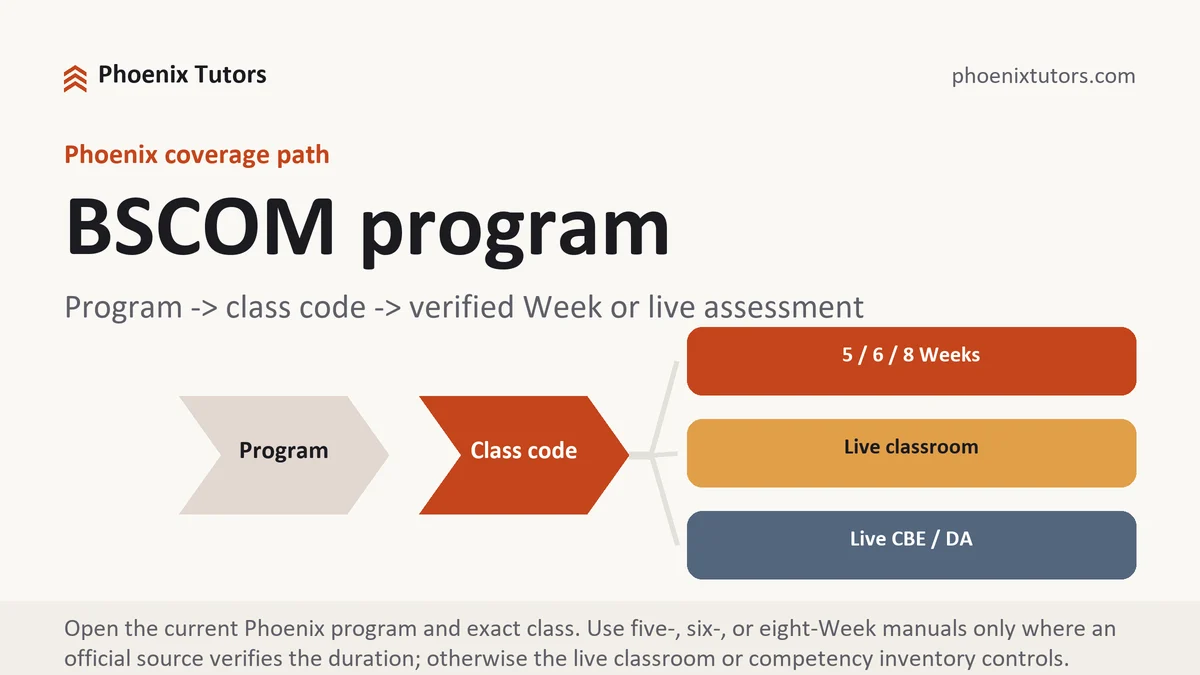
This is a traditional, letter-graded program. Where a current official program source states a five-, six-, or eight-Week class duration, the canonical class page links exactly that many positional Week manuals. Otherwise the registered classroom remains the honest cadence boundary.
Before scheduling support, reconcile this map with the current academic plan. Confirm catalog year, modality, admission status, prerequisites, transfer work, electives, substitutions, clinical placement, practicum or residency requirements, and advisor approval. Preserve alternatives as alternatives. A class listed inside an option or pathway is not automatically required for every student.
The classes, one by one
Open a code for its full class guide, current catalog focus, every mapped program context, session boundary, rubric workflow, grade controls, and right-side navigation. Shared classes own one canonical page so their guidance cannot drift between degrees.
Catalog curriculum, pathways, and options
| Class | 2026-2027 catalog title | Credits | Cadence control |
|---|---|---|---|
| BSCOM/100 | Introduction to Communication | 3 | Week 1-5 |
| BSCOM/210 | Logic and Rhetoric | 3 | Week 1-5 |
| BSCOM/230 | Storytelling | 3 | Week 1-5 |
| BSCOM/250 | Communication Technology | 3 | Week 1-5 |
| BSCOM/310 | Interpersonal Communication | 3 | Week 1-5 |
| BSCOM/320 | Mass Communication and Media | 3 | Week 1-5 |
| BSCOM/340 | Organizational Communication | 3 | Week 1-5 |
| BSCOM/350 | Journalism: Writing for Impact | 3 | Week 1-5 |
| BSCOM/370 | Social Media Communication | 3 | Week 1-5 |
| BSCOM/380 | Corporate Communication and Public Relations | 3 | Week 1-5 |
| BSCOM/400 | Technical Communication | 3 | Week 1-5 |
| BSCOM/420 | Global and Intercultural Communication | 3 | Week 1-5 |
| BSCOM/450 | Negotiation, Mediation, and Diplomacy | 3 | Week 1-5 |
| BSCOM/480 | Applied Communication Capstone | 3 | Week 1-5 |
| MGT/526 | Managing in a Changing Environment | 3 | Live registered classroom syllabus |
| ORG/535 | People and Organizations | 3 | Live registered classroom syllabus |
| LDR/535 | Leading Change | 3 | Live registered classroom syllabus |
| ENT/527 | Opportunity Assessment and Innovation | 3 | Live registered classroom syllabus |
Program → class → Week or live registered classroom syllabus
14 mapped class code(s) also occur in official Phoenix program contexts that state 5-Week classes. Those canonical class pages link the exact supported Week positions. The registered classroom still owns the real Week topic, assessment name, directions, rubric, and deadline.
For each registered class, copy section, instructor, start and end dates, due-day pattern, time zone, grading model, late policy, required technology, and final-submission window from MyPhoenix and the registered classroom. Then inventory the real work: discussions, replies, quizzes, papers, cases, presentations, projects, labs, simulations, competency assessments, clinical or practicum records, and exam-preparation blocks.
A Week number is a position, not an assessment identity. Preserve the exact live title, directions, rubric version, template, permitted sources and tools, point value or weight, file type, deadline, and submission location before production. Announcements that amend a requirement belong in the same control packet.
Build the session board
Give every obligation one row with class code, exact registered classroom label, Week or date, due time and time zone, points, weight, competency result, dependency, evidence need, permitted tools, current status, feedback status, and next action. Keep different work types separate because a discussion, quantitative problem, presentation, clinical record, competency assessment, and proctored-exam preparation block do not share one completion test.
Work backward from the deadline. Reserve intake time for directions and rubric, evidence time for research or data, production time for the actual deliverable, and a delivery pass for citations, accessibility, filename, file type, export, and upload rendering. A short class compresses these blocks; it does not remove them.
Reconcile after every posted result. Use raw points only when the syllabus is points-based; calculate weighted categories independently when weights control. Keep full precision until display and track any separate exam-average, clinical, competency, attendance, or progression floor as its own gate.
Turn the live rubric into acceptance tests
Directions and rubric are separate contracts. Directions control scenario, audience, length, format, source limits, tools, and submission rules. Rubric rows control scoring evidence. Translate each requirement into a yes-or-no test and assign it a visible destination in the paper, calculation, presentation, care document, project file, or discussion.
Read verbs literally. Describe requires accurate coverage; compare requires a visible basis; analyze requires relationships and implications; evaluate requires criteria and judgment; recommend requires a defensible choice tied to evidence. Universal words such as all, each, and every change the minimum complete response.
Run content quality before delivery quality. Check coverage, logic, evidence quality, calculations, and consistency across prose, tables, figures, slides, and appendices. Then check citation matching, template fields, accessibility, filename, file type, and rendered export. A polished file cannot compensate for a missing decision, and good analysis can still fail when the wrong file is uploaded.
Clinical, professional, and exam boundaries
Students perform patient care, clinical decisions, skills, simulations, laboratory activity, practicum or rotation hours, preceptor communication, signatures, experience logs, group participation, identity-verified activity, and final submission. Remove protected health, client, employee, and proprietary information before any tutoring review.
Proctored, standardized, competency, dosage-calculation, readiness, and licensure-related assessments are preparation-only. Legitimate support includes a study blueprint, practice questions, rationale review, calculation practice, concept explanation, rehearsal, and readiness decisions. It does not include entering an authenticated environment or completing the real assessment.